
Commercial Roof Edge Metal, Coping and Gutters in Orange, CA
A pulled fastener beside an edge cleat can leave metal unsecured even where the cap still looks straight. We examine the restraint connection, adjoining attachment and membrane termination before selecting replacement or reconstruction. Roof edge-metal work in Orange, CA needs a secure connection suited to the assembly, not merely an undamaged visible profile. Commercial Roofers Orange identifies the failed attachment and any support work required behind it. Close photographs locate the affected cleat or fastening area, while physical checks establish how far the repair must extend to reconnect with suitable components.
Businesses in Old Towne Orange operate among historic structures, making visible roof edges and protection below them important during repair. The commercial district of Savi Ranch spans Yorba Linda and Anaheim and contains offices, retail, restaurants and hotels. A gutter repair above an entrance there needs safe work access and a clear discharge route. We examine the individual building's edge and operating use before deciding the replacement dimensions or the protection needed below the damaged component.
Backing must support the connection
A loose face of metal can conceal deteriorated wood, corroded attachment or an unsuitable fastening arrangement. We inspect the accessible support and open selected areas where concealed condition changes the repair. Replacing the cap alone can leave movement in the backing that caused the original problem. The scope identifies the support correction needed before new metal is installed, with structural concerns referred for appropriate evaluation where the findings require it.
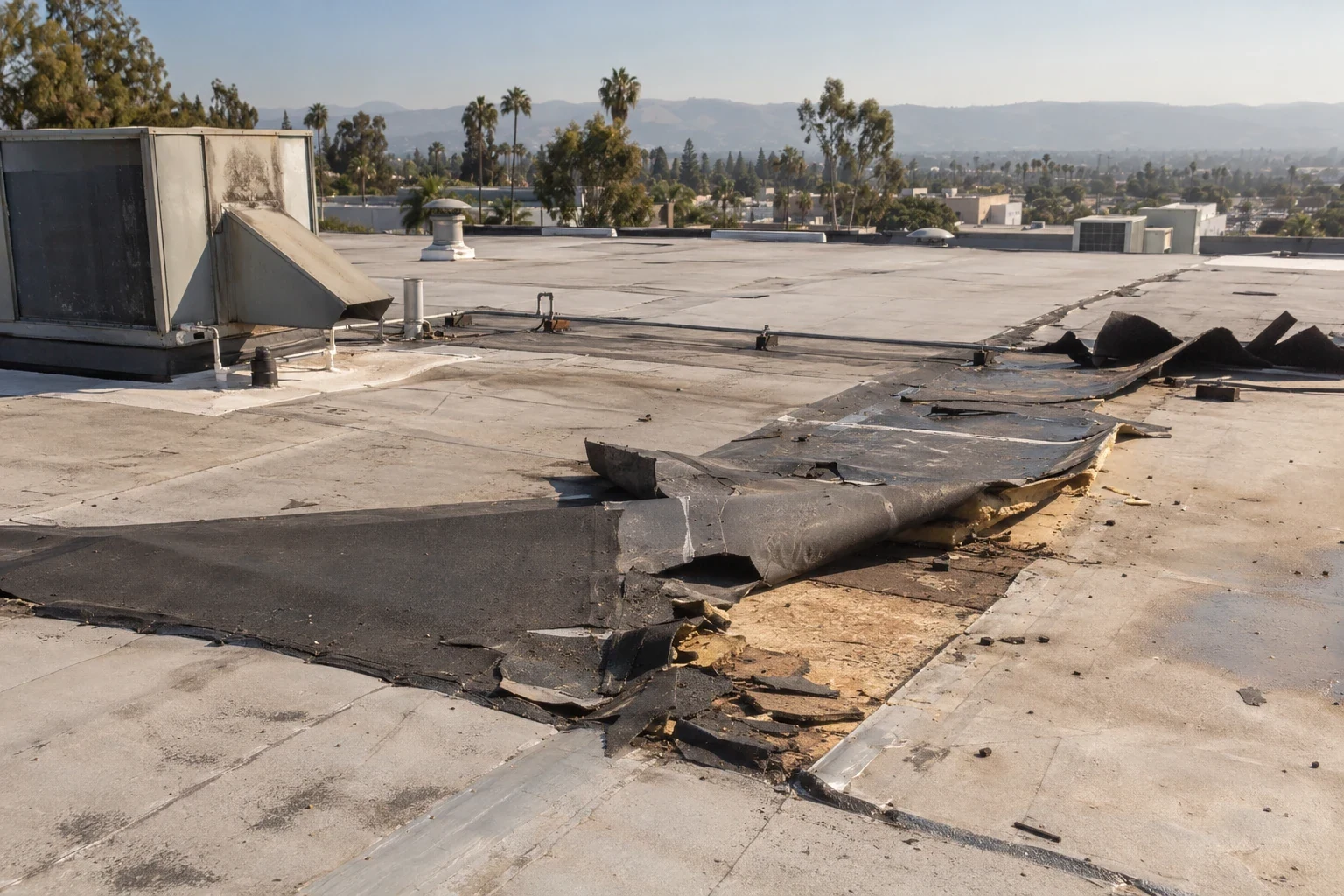
At the perimeter, attachment must fit the roof design and the component being installed. We assess cleats, fasteners and connections alongside the membrane transition. Wind-affected edge damage can extend into adjacent components even where only one section is visibly bent. The repair limit follows that inspection. New metal is fitted to the actual assembly rather than forced onto damaged or incorrectly sized backing.
Joints need room for movement
A metal joint that has opened deserves examination of overlap, seal placement and the movement it must accommodate. Long runs can expand and contract as conditions change. A joint repair needs the appropriate geometry and connection for the selected edge system. We identify where a localized correction can function and where replacement is needed because the old pieces cannot form a suitable joint. The owner can see the failed connection and proposed boundary in close views.
Corners, changes in height and transitions to walls need particular attention. An improvised corner may interrupt drainage or leave the membrane termination exposed. We measure the available profile and reconstruct the connection using a detail suited to the roof. Flashing work at adjoining transitions may be needed where edge repair reaches another component. Those related tasks are included in the work sequence rather than left as an unexplained gap between trades.
Gutters receive the roof's discharge
A gutter filled with sediment can overflow without a defect in the field membrane. We examine the gutter profile, outlet and downstream path, then check corrosion and joint condition. Roof outlets and scuppers feeding the gutter need compatible connections and an unobstructed route. Cleaning and joint reconstruction are different tasks, so we describe which condition each part of the scope corrects.
A downspout can also be restricted or displaced where it meets the receiving system. We assess accessible connections and coordinate discharge work beyond the roofing scope with the responsible trade. Water should leave through the intended route rather than spill across an entrance or return toward a wall detail. Where capacity or arrangement needs redesign, the owner receives that requirement before a replacement section is fabricated and installed.
Profiles fit the repaired assembly
A roof recover can raise the membrane above the position accommodated by old edge metal. We examine assembly height and the termination detail before proposing reuse. Adding a new roof layer may therefore require edge replacement even when the visible cap has little corrosion. The new profile needs to connect to the roof and support the required attachment while preserving drainage and the intended exterior arrangement.
At a property in Old Towne Orange, a visible edge also needs consideration alongside the building's historic setting. We establish the applicable project requirements and the physical repair before fabrication. The scope comparison identifies material condition, dimensions, backing work and access. Those details help the owner compare a local joint correction with replacement of a longer run whose support or profile needs rebuilding.
Work areas need separation below
A loose component over an occupied walkway creates a reason to protect that area while inspection or removal is underway. We plan access, material handling and pedestrian separation for the affected edge. On an auto-dealership property, vehicle movement and display areas can influence lift placement and the work sequence. The operating arrangement is agreed for the actual repair location before metal is removed.
Southern California Santa Ana winds bring dry air and can damage property. We assess present conditions when planning edge removal and installation so loose material is handled safely. Temporary weather protection keeps an opened transition controlled between removal and closure. Completed work receives checks of the attachment, joints and membrane connection. The owner is told which repaired components need future review after equipment work, debris accumulation or another damaging event.
Follow the repaired discharge route
A completed gutter joint needs inspection at its connection and attention to any remaining restriction farther along the run. We show the corrected area and explain what cleaning or separate discharge work remains. For coping, follow-up views relate the rebuilt joint to recognizable parapet features. This makes later movement easier to locate and investigate. Maintenance tasks are directed at those physical components rather than a general instruction to watch the roof.
Questions About Commercial Roof Edge Metal, Coping and Gutters
Can loose coping be repaired without replacing the backing?
Suitable backing can remain where its condition and attachment support the proposed repair. We examine it before selecting a fastening correction. Deteriorated or moving support needs attention beneath the cap, which may require removal to reach it. The recommendation separates metal replacement from backing reconstruction and explains why each task is included or retained. We also check how the cap meets its neighboring section. A corrected support needs a joint arrangement that accommodates the metal, otherwise movement can return at the edge of the newly repaired area.
Why does a gutter still overflow after debris removal?
A downstream restriction, outlet arrangement or inadequate slope can leave discharge interrupted even after the visible gutter is clear. We trace the accessible path and assess the remaining cause. A damaged connection may also release water before it reaches the outlet. The proposed work identifies that condition so the owner can arrange the appropriate repair instead of repeating cleaning alone.
Will new edge metal have the same dimensions as the old pieces?
Replacement dimensions follow the repaired roof assembly and required connection. Changed insulation height, unsuitable profiles or reconstructed backing can make the old dimensions impractical. We measure the actual transition before fabrication and explain the resulting profile. The work must accommodate the roof and its support, not merely reproduce a component that contributed to the failed detail.
Should adjoining membrane work be included with a coping repair?
The membrane termination needs examination whenever the edge connection is opened. Torn, detached or poorly supported material may require compatible reconstruction beside the metal. We define that boundary and inspect the finished transition after installation. Keeping the tasks coordinated helps avoid a sound new cap sitting above an unresolved water entry path at the roof connection.
Related Roofing Work

Inspect the moving edge
Describe the Orange building's loose metal, gutter overflow or damaged joints and access below the edge. We can examine the support and explain a connected repair scope. Call 555-555-5555 or request a roof assessment.